

Courses numbered between 100-120 are intended to be gateway courses that introduce the discipline of Comparative Literature.
Great art constantly morphs: novels become films, statues become poems, music becomes dance. This introduction class looks at how masterpieces from around the world transform as they move across languages, art forms, and renditions. In addition to written assignments, we do creative projects to explore each of those modal shifts. We also learn about the structure of a range of languages, and think about how those languages shape their literatures. This is a great class to take if you’re thinking about learning a new language in the future. It’s also a good entryway to other literature and language classes for first- and second-year students, as well as students concentrating in fields outside the humanities. This course also counts toward the Secondary Field in Translation Studies. Taught in English; no other languages required (just curiosity).
The novel has been described as the quintessential literary form of modernity, but do we know what a novel actually is? And is it just a modern form? In this seminar we will look at a range of pathbreaking works that have bent the norms of prose fiction and have opened up new ways of understanding the world, from antiquity to the present. Readings will include selections from The Odyssey, The Tale of Genji, and Don Quixote, together with a range of modern novels, informed by several important statements on the novel, especially by the writers themselves.
Examines trends, issues and debates in the comparative study of mystical literature.
Close readings of primary works by Jewish, Christian and Muslim authors from the Middle Ages through the 16th century. Topics include poetry and mysticism; allegory, symbolism and Scripture; the rhetoric of ineffability; body and gender; apophasis vs cataphasis; exemplarity and autobiographism; language and experience. Also examines creative engagement of pre-modern mystical literature in selected works by modern authors and literary theorists.
This course will introduce students to writing by major pioneers of twentieth century Arabic literature and to cultural histories of the Middle East through the reading of literary texts. Readings drawn from a diversity of national contexts will include historical novels, short stories, experimental prose narratives, and selections from among the most influential poets of the twentieth century. Against the backdrop of Ottoman and Western European imperial domination within West Asia and North Africa, students in this class will explore how the development of modern Arabic literature has been variously understood by writers and critics: as a response to classical literary influences, as a force for political change, as a form of decolonial engagement, and as a source of cultural and linguistic cohesion after the dissolution of the Ottoman empire in the early twentieth century. Although readings will be consulted and discussed in English translation, Arabic or bilingual versions will be made available to those interested, and an attention to the politics of language will be considered through secondary readings on the controversial difference between regional dialects and transregional standards of literary Arabic.
The first Asia-Africa conference of newly independent states (held in Indonesia in 1955) was hailed by contemporary observers as an event as significant as the European renaissance in global importance. It inspired a sequence of political and cultural initiatives in pursuit of new forms of cultural exchange unmediated by former colonial centers. This course explores the historic tensions of this transition towards a post-colonial global order across two continents. The course raises the following questions: how did anti-colonial African and Asian authors and political figures consider the fields of culture and literature as an extension of their political engagements? How were literature and culture viewed as advancing forms of revolutionary change, or addressing entrenched social grievances? How did writers reconcile the ambiguities of national independence with the risks of neo-colonial or ethno-nationalist exploitations? The course will introduce you to a diversity of authors to explore these questions, engaging with counter-imperial and revolutionary writing from African and Caribbean contexts, the Middle East, and Southeast Asia.
Between 1923 and 1970, Jorge Luis Borges wrote some of the most original poems, short stories, essays and film scripts in Latin America and anywhere in the world, and he redefined the meaning and scope of literature. In this course, we will examine the signifying power of Borges’ short stories, essays and poems, and we will consider his work as a literary machine whose output radically transforms aesthetic formations and imaginaries beyond Argentina and Latin America. Rather than thinking about what his literature means, we will concentrate on what it produces as a fictional-poetic machine: cities and worlds, love and treason, popular and high culture, politics and death, institutions of knowledge and traditions, and new ways of reading and thinking about aesthetic and social relations (this year, the course will be taught in Spanish).
The seminar provides an opportunity to read through, absorb, and reflect upon Marcel Proust’s monumental novel, In Search of Lost Time (À la recherche du temps perdu, 1913–1927), considered alongside key essays by French, German, and English literary critics and theorists. Major themes include but are not limited to: involuntary memory; topologies of time; love, sexuality, jealousy, and manipulation; aesthetics of music, literature, and the visual arts; nature and the mind; individuality and social hierarchies.
This course examines a diverse range of creative and critical discourses on migration, diaspora, and trauma: African; East, South, and Southeast Asian (Chinese, Indian, Korean, Vietnamese); as well as Latin American and Caribbean. We focus on connections among diasporas, displacement, migration, and trauma, and on the relationships of these phenomena and constructions and understandings of artistic and cultural identities, ethnicity/race, gender/sexuality, inequality, disease/mental illness/mental health/disability, religion, postcolonialism, transculturation (including translation), multilingualism, globalization and global history, world literature, global literatures, and related fields.
Now Fall 2026
By focusing on literary narratives, cultural representations, and critical theories, this course explores ways in which issues related to migration create rich and complex interdisciplinary conversations. How do humanistic disciplines address these issues—human rights, cultural translation, global justice, security, citizenship, social discrimination, biopolitics—and what contributions do they make to the “home” disciplines of migration studies such as law, political science, and sociology? How do migration narratives compel us to revise our concepts of culture, polity, neighborliness, and community? We will explore diverse aspects of migration from existential, ethical, and philosophical perspectives while engaging with specific regional and political histories.
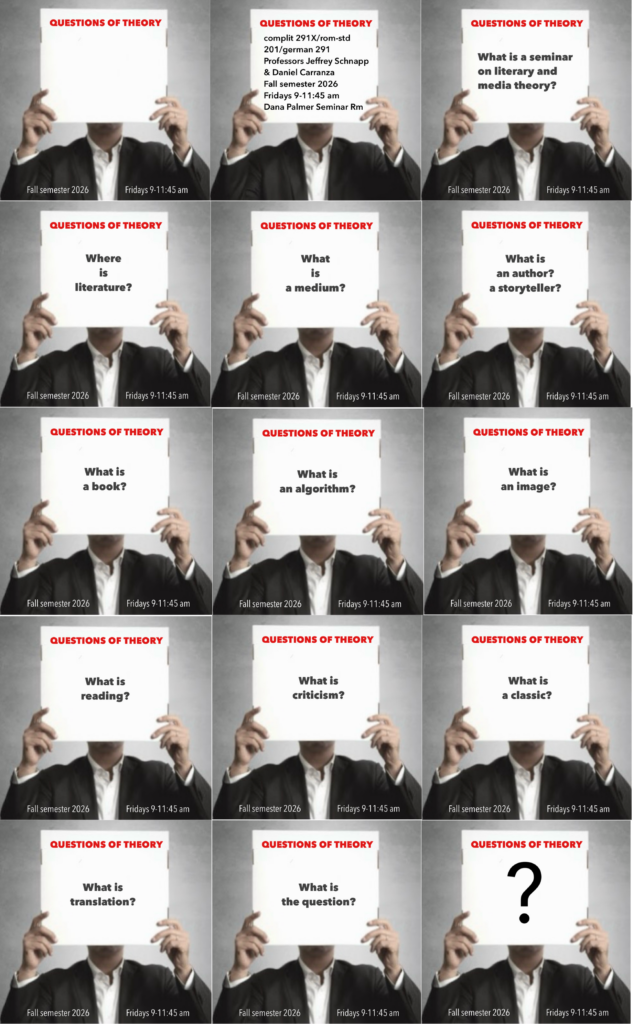
The seminar is built around a sequence of fundamental questions regarding the literary disciplines and media studies, their history and epistemology. Discussions are instigated by readings in philology, stylistics, the history of ideas, semiotics, structuralism, psychoanalysis, post-structuralism, film and media theory, genetic criticism, literary sociology, cultural studies, and digital humanities.
An introduction to the discipline of comparative literature, looking at major issues in the history and current practice of the discipline as practiced in the USA, with special emphasis on seeing how comparatists enter into ongoing debates concerning theory and method. Several of our faculty will join us for the discussion of their work. Additional readings will include selections from Herder, de Staël, Adorno, Auerbach, de Man, Glissant, Said, Spivak, Apter, Venuti, and Heise.
This course has several interrelated but distinct missions. First, we read selected major works from the history of attempts to theorize translation. Second, we read an array of contemporary examples of research on translation. Third, students have an option of drafting a research article or undertaking a major translation project. Graduate students from any discipline are welcome! Interested undergraduates need to have taken other prior coursework on translation, and should receive instructor approval to enroll. This seminar is the capstone requirement for the Graduate Secondary Field in Comparative Literature.
This seminar will focus on the formal structures of the epic genre. Through a comparative approach, we will study the narrative, stylistic and linguistic components of the epic genre across the Greco-Roman epic tradition. Formulae, sacrifices, arming scenes, combat and death, catalogues, storms, and messenger scenes are some examples of recurrent epic structures. What can the handling of these mundane elements of the epic genre tell us about each poet’s narrative approach and poetics? What flexibility for innovation is created by the fixity of these structures? What, if any, is the ideology of epic forms and how does it evolve? A comparative study of Homer’s Iliad and Virgil’s Aeneid will be used as a point of departure for the study of each device. Class participants will be asked to adopt one other epic work (e.g. Odyssey; Apollonius of Rhodes, Argonautica; Ovid, Metamorphoses; Quintus of Smyrna, Posthomerica, etc.) and become class experts over the course of the semester. Scholarship on ancient epic will be read side-by-side with modern theoretical work on epic narrative, time and space.
This course explores the impact of AI on the humanities and seeks to articulate a humanities-based perspective on AI. This double mission includes discussions of how AI uses text corpora; how it imitates existing genres and styles; and larger questions of creativity and authorship. We’ll also look at the history of dialogue in order to understand our interactions with AI though conversational interfaces or chats. This attention to dialogue will include source texts such as the Socratic dialogues, Buddhist Sutras, and Confucian Analects, as well as theoretical readings by Nina Beguš, Murray Shanahan, and others.
At the same time, this course functions as a lab in which we’ll try out different applications of AI in a humanities context. We will develop different uses of AI as an analytical tool, as a research tool, and as a sparring partner as well as AI-enabled coding tools that can help create humanities-based websites and apps (no coding experiences required). This part is aimed at those eager to engage with AI in an experimental or entrepreneurial mode. We’ll look at recent projects such as Blinkist, Stoa, and other humanities-based applications.
An additional goal of the course is to create the contours of a humanities-based AI Lab that participants can continue to use for their own projects after the course is over.
In a time of rising authoritarianism and polarized debate, what role can the love of wisdom have in tempering the pursuit of power?
Philosophers and politicians alike struggle to set the terms for living a good life in a world of conflict. Rulers seek guidance from their counselors, and philosophers have often dreamed of wielding real-world influence. Reading a series of masterpieces of philosophical thought and literary expression, we will examine some striking cases of relations between the pursuit of wisdom and the pursuit of power, from the extremes of conflict (the executions of Socrates, Han Fei, Jesus, Sir Thomas More) to the opposite dream of the philosopher king. How do seekers of wisdom speak truth to power? How do rulers understand their ethical responsibilities toward their often fractious subjects? How do rulers and subjects alike weigh the competing demands of liberty and order, self-fulfillment and self-restraint? Moving from ancient to modern examples, this course will see how the insights and methods of Plato, Machiavelli, Shakespeare, and Hannah Arendt can be useful in working through contemporary conundrums of wisdom and power.
How did ancient Greek heroes, both male and female, learn about life by facing what all of us have to face, our human condition?
How to face death? Concentrating on this central human question, we will explore some of the greatest works of ancient Greek literature in English translation. For the Greeks, a special way to address the problem of death was to think long and hard about what they called heroes in their myths. Our purpose in this course is to extend that kind of thinking to the present. Assignments invite you to engage in personal reflections on the meaning of life and death in the light of what we read in Greek literature about the ordeals of becoming a hero.
Mental health experts believe that globally, more than 1 billion people have a mental illness. And yet the biases and misperceptions surrounding mental illness, not to mention the dehumanization, isolation, and abuse in many communities of individuals with a mental illness, remains acute. This course uses literature and the arts to help students learn more about some of the prevalent biases/misperceptions/myths/stigmas against individuals with mental illness and how these biases can be (or in the past have been) ameliorated, ameliorating loneliness and suffering for all.
This course ordinarily counts for premed requirements in writing and literature. Weekly assignments combine readings of literature/film screenings, etc. with a range of secondary sources. For the final project, students have the option of a traditional paper or a creative project. The course will include guest speakers and visits to the Harvard Art Museums and other local resources.
A Humanities Colloquium: from Homer to Joyce: 2,500 years of essential works, taught by six professors. Humanities 10a will tentatively include works by Homer, Sappho, Sophocles, Plato, Virgil, Dante, Boccaccio, Shakespeare, Descartes, Du Bois, Kafka and Woolf. One 75-minute lecture plus a 75-minute discussion seminar led by the professors every week. Students will receive instruction in critical writing one hour a week, in writing labs and individual conferences. Students also have opportunities to participate in a range of cultural experiences, ranging from plays and musical events to museum and library collection
Explores the reception of Greek culture in Nazi Germany and the cultural, historical, and political implications of the occupation of Greece by the Nazis. Emphasis will be also placed on holocaust memoirs by Greek Jews.
Opera as the New Greek Tragedy. This class is about love, hatred, hubris, punishment and destiny as they have been sung on operatic stages in the last four centuries. Opera history will be studied from the perspective of its use and transformation of classical mythology. From Orpheus to Elektra, from Iphigenia to Ariadne, from Hercules to Dido, this class will explore not only the evolution of the operatic genre, but also the evolution of the multiple interpretations of classical mythology’s many enigmas.
The course provides a lively, in-depth introduction to fascism, its philosophical and political roots, its critique of liberal democracy and socialism, and the traces fascism has left on the contemporary cultural-political scene. It begins with readings from key fascist thinkers and theorists, before surveying a series of domains where artists, writers, architects, film-makers, and engineers sought to interpret and embody the “fascist revolution” not just in Italy but worldwide. Among the figures considered are mystical nationalists like Gabriele D’Annunzio; Filippo Tommaso Marinetti, founder and leader of the Futurist movement; the American poet Ezra Pound, author of the Cantos, one of the masterpieces of 20th century American poetry; Leni Riefenstahl, the film director of classic documentaries such as Olympia and Triumph of the Will; the architects Marcello Piacentini and Adolf Speer, the former Italy’s leading designer of public monuments and buildings during the Mussolini era, the latter Hitler’s preferred architect; and the engineer Gaetano Ciocca, creator of everything from Corporativist pig farms to mass-produced worker housing to mass sports stadia. Course themes will include: fascism vs. nazism; collectivism vs. individualism; radical right attitudes towards technology and industrialization; and examinations of the convergences and divergences between mid-20th century fascisms and the sub-cultures of today’s alt-right.
This course will introduce students to classical forms of the Tamil language, through a graduated study of poetry. During this semester, we will read the Purattinaiyiyal, the chapter on poetic convention from the classical grammar Tolkappiyam. Students are required to have a minimum of two years of formal Tamil study (or equivalent)
This seminar will introduce students to the art of literary translation through a wide variety of approaches. Over the course of the semester, we will read various tracts, articles, and books on the theory and craft of translation from a wide range of Euro-American and South Asian stances and viewpoints. We will analyze editions of various classics from India that have been translated into English repeatedly, paying particular attention to the political nature of the act and art of translation in its colonial and post-colonial contexts. This seminar will also have a practical component, and one session each week will allow students to present translations-in-progress to their peers for comment and critique.
If you’re taking this course, it means Comparative Literature is your concentration or your secondary field. Welcome to the discipline! But what does it mean to be a comparatist? This spring, we will wander together through the different paths Comparative Literature offers.
This is a course on history and methods. We will trace how the understanding of what it means to compare has changed through time and space. We will examine the sociopolitical roots of the discipline and think together with the intellectuals who shaped its different stages. To tell the stories of the discipline is, of course, also to inquire into its methods. We will experiment with different analytical modes, and see how they allow us to interact with literary texts. And we will explore theoretical and critical possibilities of both grounding and expanding our readings.
This course will explore contemporary literature and cinema across Southeast Asia, focusing on regional developments after the Asian financial crisis of 1997 through the present. Themes discussed include literature’s relationship to economic turmoil and political change; questions of class and social mobility; anti-authoritarian writing and issues of censorship; literature, youth culture, and new media landscapes; and literary explorations of gender and sexuality. Readings will include a selection of critical essays to foreground these central themes of the course, along with poetry, short fiction, and films from: Brunei, Cambodia, Laos, Indonesia, Malaysia, Myanmar, the Philippines, Singapore, Thailand, Timor-Leste, and Vietnam. Readings will be taught in English translation and films will be screened with English subtitles.
Examines theories of translation from various periods (Dryden, Schopenhauer, Schleiermacher, Benjamin, de Man, among others). Also looks closely at specific translated texts (e.g., various English translations of The Thousand and One Nights), and considers such topics as the notion of unequal languages, the problem of cultural translation, translation post-9/11, and the possibility of untranslatability. Final project involves an original translation and commentary.
A re-examination of “Lyric” as occasion as well as genre. Central questions to be explored will include: how do the “lyrics” of composed song come alive in performance? For example, how do the two librettists of Puccini’s opera La Bohème contribute to the making of a masterpiece in song? Shared readings include The Lyric Theory Reader: A Critical Anthology, edited by Virginia Jackson and Yopie Prins. Students are free to select as their focus of research any particular “lyric” traditions, composed in whatever language. No previous knowledge of literary theory is presumed.
This course offers an introduction to contemporary Arabic literature focusing on developments after the seismic period of regional transition within North Africa and the Middle East known as the “Arab spring.” Course readings will include critical essays and literary texts that reflect the forms of cultural reckoning that anticipated and followed the popular uprisings of the period, drawing principally from literary figures across Algeria, Egypt, Libya, Syria, and Tunisia. Themes explored through the course include questions of political change and anti-authoritarian writing; literary innovations across new media landscapes and censorship regimes; revisionist historical fiction in the wake of major political transitions; and intergenerational influences on rising authors. Texts will be taught in English translation and films screened with English subtitles.
In this course, students will read English translations of novels that have won major prizes. In addition to exploring themes of contemporary literature from around the world, special attention will be paid to the role of translation in shaping the work and its reception, and to the question of what makes for a prize-winning translation. Each week students will read a prize-winning translation alongside reports from the prize committee, reviews of the translation, and what the translators say about their work.
This course satisfies the Arts & Humanities distribution requirement, counts towards the Secondary in Translation Studies, and may be taken pass/fail upon application.
A close reading of the major fictional, dramatic, and essayistic works of Kleist focuses on questions of grace, order, and stability in relation to the antithetical forces of falling and failing, chance and inscrutability, destabilization, uncertainty, and self-consciousness. In addition to developing methods for literary analysis and interpretation, the course further explores issues of Kleist’s historical context and his varied reception across the centuries
Cosmopolitanism has been a vital master concept for understanding modern and modernist processes of global circulation, disjunction, and transnational/translational formations and subjectivities. Today, the displacement of more than 122 million refugees, migrants, and forcibly displaced persons driven by environmental catastrophes, economic hardships, and small and large-scale perpetual wars in Latin America, Africa, the Middle East, Europe, and East Asia points to the radical dislocation of the symbolic structure we used to call “world.” Is the concept of cosmopolitanism still useful for interrogating this generalized sense of global crisis? Can cosmopolitanism still be posited as a radical utopian horizon from which to oppose the militarization of the globe? What is the ethico-political potential today of “a cosmopolitanism without a world”? This seminar is not about the very real historical suffering and losses of those whose bodies are wounded by the political, economic, military, and environmental upheavals; rather, it is about the post-cosmopolitan traces of those experiences in art, literature, film, and theory, and about how we can determine what art and the critical humanities can and can no longer do about the contemporary experience of what we will call “the end of the world.
The cultural interactions in premodern Iberia between Muslims, Christians and Jews shaped the literary history of Arabic, Hebrew and the Ibero-Romance vernaculars. Our seminar examines selected scholarly debates on the comparative study of these literatures, with an overarching focus on the theory and practice of translation.
From traditional folktales reimagined on Netflix to groundbreaking novels and bold Nollywood productions, we’ll discover how African writers and filmmakers have shaped and reshaped the continent’s image from the 1950s to today. Together, we’ll read powerful works by authors like Chinua Achebe, Ngugi wa Thiong’o, Dambudzo Marechera, Ama Ata Aidoo, Binyavanga Wainaina, Namwali Serpell among others, and engage with cinematic works by directors such as Ousmane Sembene and Tsitsi Dangarembga. We’ll explore how these creators respond to colonial histories, challenge stereotypes, celebrate culture, and imagine new futures. Students will gain tools to think critically about representation, identity, language, and power and to appreciate Africa not as a single story, but as a continent of vast creative voices and visions. No prior knowledge is expected – just curiosity, openness, and a willingness to see the world differently.
What do humanist scholars do and how do they do it? This preparatory course introduces students to the fundamental skills, techniques, and methods that are applicable for study in any one of the disciplines offered in the Humanities, including languages and literatures, philosophy and theory, music, performance and the visual arts, from antiquity to the present. Through a comprehensive and systematic explication of cross-disciplinary terminology, participants acquire the tools necessary for interpretation and analysis, for critically engaging with what has been produced, expressed, and argued by artists and thinkers across the world’s epochs and cultures.
A Humanities Colloquium: from Homer to Joyce: 2,500 years of essential works, taught by six professors. Humanities 10b will tentatively include works by Joyce, John Stuart Mill, Mary Shelley, Austen, Schiller, Augustine, Apuleius, Epictetus, Sophocles, and Homer, as well as the Bible. One 75-minute lecture plus a 75-minute discussion seminar led by the professors every week. Students will receive instruction in critical writing one hour a week, in writing labs and individual conferences. Students also have opportunities to participate in a range of cultural experiences, ranging from plays and musical events to museum and library collections.

Founded as a graduate program in 1904 and joining with the undergraduate Literature Concentration in 2007, Harvard’s Department of Comparative Literature operates at the crossroads of multilingualism, literary study, and media history.
© 2023 President and Fellows of Harvard College
Sign up to receive news and information about upcoming events, exhibitions, and more
